
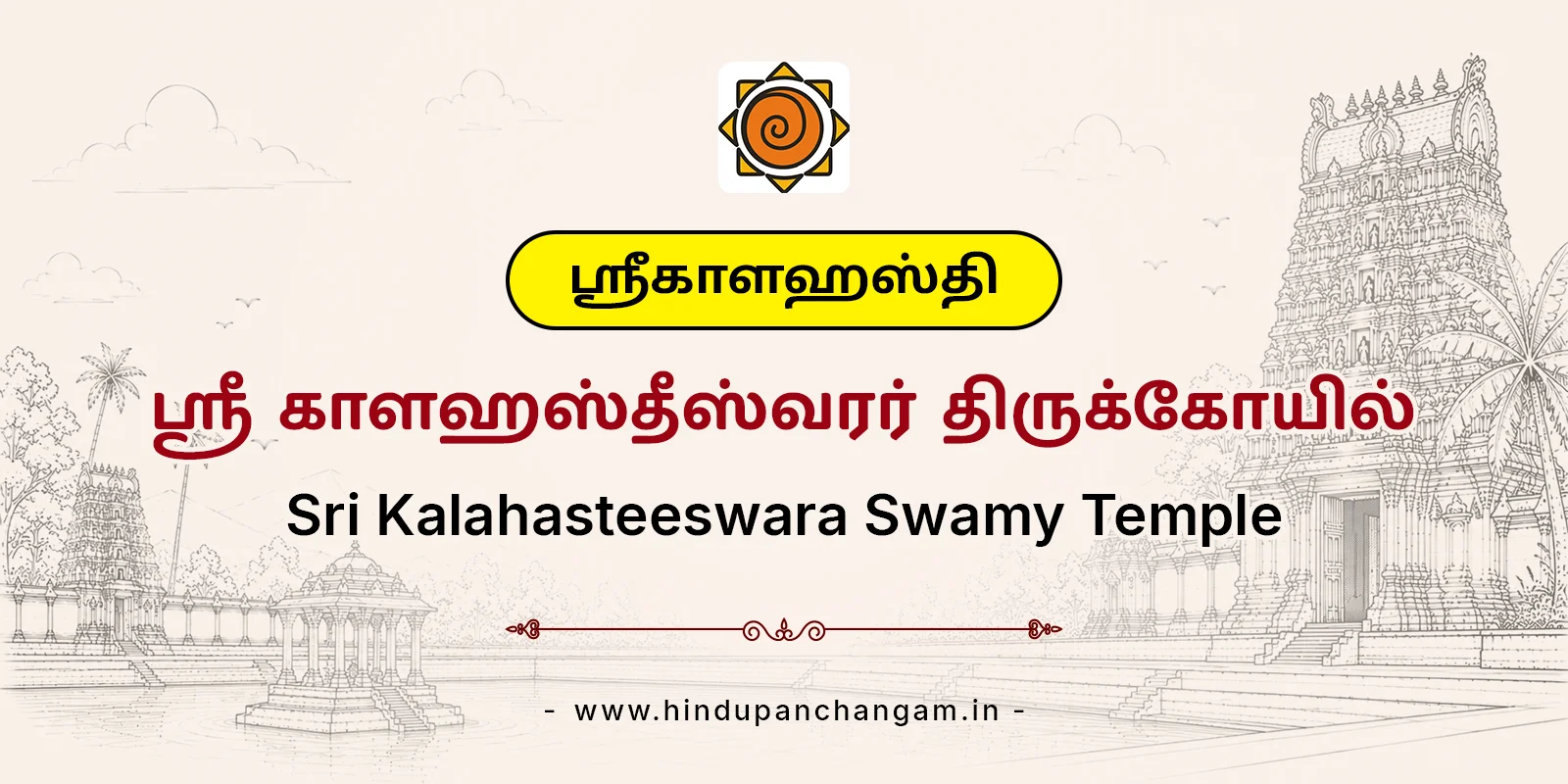
Sri Kalahasteeswara Swamy Temple
Sri Kalahasteeswara Swamy Temple, popularly known as Srikalahasti Temple, is one of the most important Shiva temples in South India. It is situated on the banks of the Swarnamukhi River in Srikalahasti town, Tirupati district, Andhra Pradesh.
The temple is especially famous as one of the Pancha Bhoota Sthalams, the five sacred temples where Lord Shiva is worshipped as the five fundamental elements of nature. Srikalahasti represents Vayu — Air.
The Lord is worshipped as Sri Kalahasteeswara, while Goddess Parvati is worshipped as Sri Gnana Prasunambika Devi.
The temple has another major distinction: it is one of the best-known pilgrimage centres for Rahu–Ketu Dosha Parihara. Devotees from Tamil Nadu, Andhra Pradesh, Telangana, Karnataka and other parts of India visit the temple to perform the traditional Rahu–Ketu Pooja / Kala Sarpa Dosha Nivarana Pooja.
Srikalahasti is also associated with the great devotee Bhakta Kannappa, whose unwavering devotion to Lord Shiva is one of the temple's most famous sacred traditions.
The temple is also a Paadal Petra Sthalam, being praised in the Tamil Shaiva canonical tradition.
The Pathala Vinayagar shrine is one of the most fascinating and unique spiritual features of the ancient Srikalahasthi Temple in Andhra Pradesh. As the name "Pathala" (meaning underground or netherworld) suggests, this sacred shrine dedicated to Lord Ganesha is situated nearly 20 to 30 feet below the main ground level of the temple complex. To seek the blessings of the deity, devotees must carefully descend a flight of steep, narrow stone steps into the subterranean chamber. According to temple beliefs, Pathala Vinayagar serves as the protector of the netherworld. Worshipping Him in this deep, cave-like setting is believed to remove deep-rooted karmic obstacles and bring profound spiritual grounding to the devotees. The mysterious and deeply peaceful atmosphere of this underground shrine makes it a must-visit spot for anyone coming to Srikalahasthi.
| Moolavar | Srikalahasteeswarar |
|---|---|
| Goddess | Gnanaprasunambikai |
| Tradition | Shaivam |
| Theertham | Swarnamukhi River, Pathala Ganga |
| Timings | 6:00 AM – 9:00 PM |
Best Time to Visit
he months from October to March offer the most pleasant weather. For performing the Rahu-Ketu pooja, Amavasya (New Moon days), Sundays, and Tuesdays during Rahu Kalam timings are considered the most astrologically powerful and effective.
Why this temple is a Parigara Sthalam
Srikalahasti is internationally renowned as the ultimate Parihara Sthalam for resolving Rahu-Ketu Doshas and Kala Sarpa Doshas. Astrologically, when the shadow planets Rahu and Ketu afflict a person's horoscope, it causes severe obstacles. Since the Lord here is believed to control all the nine planets, performing poojas at this temple nullifies the negative impacts of these planetary doshas.
Who should worship?
By Planet — Rahu
- Individuals currently undergoing Rahu Mahadasha (an 18-year period) or Rahu Antardasha.
- People with Kala Sarpa Dosha or Rahu Dosha in their birth chart (Kundli).
- Those facing sudden downfalls in career, unexplainable delays in marriage/childbirth, sleep paralysis, or constant mental confusion.
- People working in tech, foreign trade, aviation, or politics who want to harness Rahu's ambitious energy.
By Planet — Ketu
- Individuals currently undergoing Ketu Mahadasha (a 7-year period) or Ketu Antardasha.
- People with Kala Sarpa Dosha or Ketu Dosha in their birth chart (Kundli).
- Those facing mysterious health issues, sudden detachment, career breaks, or feelings of isolation.
- Seekers of spiritual enlightenment, occult knowledge, intuitive growth, and Moksha (liberation).
Mantra & Slokam
By Planet — Rahu
Om Nagadhwajaya Vidmahe · Padmahastaya Dhimahi · Tanno Rahu Prachodayat
By Planet — Ketu
Om Aswadhwajaya Vidhmahe Soola Hasthaya Dheemahi Thanno Ketu Prachodayath
Parigaram Items
By Planet — Rahu
| Item | Purpose |
|---|---|
| Black Urad Dal (Black Gram) | Donate |
| Mandarai Flower (Orchid Tree Flower) | Pooja |
| Black or Dark Blue Cloth | Donate |
| Arukampul (Durva Grass) | Homam |
| Urad Dal Vadai (or Sesame Rice) | Offered as Naivedya |
By Planet — Ketu
| Item | Purpose |
|---|---|
| Kollu (Horse Gram) | Donate |
| Red Lily | Pooja |
| Multi-colored Cloth | Donate |
How to perform Parigaram at home
By Planet — Rahu
The simplest and most effective home remedy is to worship Goddess Durga or Lord Bhairava, as they control Rahu's energy.
- When: Tuesday, Friday, or Saturday evenings (or during Rahu Kalam).
- How: Light a mud lamp with mustard oil or sesame oil (Nallennai) facing the South-West direction. Chant the Rahu Gayatri mantra 108 times using a Rudraksha mala. Keep a small piece of sandalwood or wear sandalwood paste on your forehead to cool down Rahu's aggressive energy.
By Planet — Ketu
The ruling deity for Ketu is Lord Ganesha. The simplest home remedy is to worship Lord Ganesha daily.
- When: Tuesdays or Saturdays.
- How: Light a mud lamp with mustard oil or sesame oil facing the North-West direction. Offer Dharba grass (Kusha grass) or Arukampul (Bermuda grass) to Lord Ganesha and chant the Ketu Gayatri mantra 108 times.
Sthala Puranam (Legend)
The name Srikalahasti itself is traditionally associated with three great devotees of Lord Shiva:
- Sri – the spider
- Kala – the serpent
- Hasti – the elephant
According to the traditional Sthala Purana, a spider, a serpent and an elephant worshipped Lord Shiva in the form of the Lingam, each according to its own nature.
The spider worshipped the Lord by creating a protective web around the Lingam. The serpent offered precious gems and ornaments. The elephant worshipped the Lord by bringing water from the river and performing Abhishekam.
Because each devotee worshipped Shiva in a different manner, conflicts arose between them. Ultimately, all three demonstrated their complete devotion and attained the grace of Lord Shiva. Thus, the place came to be associated with the names Sri + Kala + Hasti = Srikalahasti.
Bhakta Kannappa
Another central legend concerns Kannappa, the hunter-devotee of Lord Shiva.
Kannappa worshipped the Shiva Lingam with complete love and devotion, without following formal ritual conventions. According to the traditional account, when he saw blood flowing from one of the eyes of the Lingam, he offered his own eye to stop the bleeding.
When the second eye of the Lingam also appeared to bleed, Kannappa prepared to offer his second eye. He marked the location with his foot so that he could place his eye correctly.
Before he could complete the sacrifice, Lord Shiva appeared before him, stopped him and blessed him.
Kannappa's extraordinary devotion is remembered as an example of pure Bhakti transcending ritual formality. He is revered as Kannappa Nayanar, one of the 63 Nayanmars.
The Vayu Lingam
The temple's innermost shrine is associated with the Vayu Lingam, representing the element Air.
A particularly famous feature is that the sanctum has no ordinary external ventilation, yet the flame near the Lingam is traditionally observed to flicker, symbolically representing the presence and movement of Vayu.
The main Lingam is traditionally regarded as one that is not touched directly by human hands, including by priests. Abhishekam is performed without directly handling the Lingam.
Parigaram (Remedy)
Devotees traditionally perform this Pooja for relief from perceived Rahu–Ketu afflictions in their horoscope.
The temple offers different categories of Rahu–Ketu Pooja tickets. Current published information lists categories including ₹500, ₹750, ₹1,500, ₹2,500 and ₹5,000, although prices and arrangements can change.
The traditional process generally involves:
- Purchasing the appropriate Pooja ticket.
- Receiving the Pooja materials/forms from the temple.
- Sitting in the designated Pooja area.
- Performing the prescribed Sankalpa and worship.
- Offering the Rahu–Ketu forms as instructed.
- Completing the Pooja under the guidance of the temple priests.
- Receiving Prasadam.
- Proceeding for Darshan of Lord Kalahasteeswara and Goddess Gnana Prasunambika.
Important practical point
A current temple-information page states that advance booking by telephone or online is not allowed through that particular site, and that tickets are purchased when devotees are physically present at the temple.
What to do when you visit
First, purchase your Rahu-Ketu Pooja ticket from the counter. After completing the 45-60 minute ritual in the mandapam, proceed directly to the main sanctum for the darshan of Lord Srikalahasteeswara and Goddess Gnanaprasunambika. Finally, drop the silver idols in the Hundi and leave the town to head directly home. You should not visit any relatives' houses or other temples after this specific parigara.
Before You Visit
Dress Code: Traditional attire is mandatory (Dhoti/Kurta for men; Saree/Salwar for women). Avoid wearing entirely black clothes.
Diet: Strictly avoid non-vegetarian food for at least 3 days before and after the pooja.
For Women: The pooja should be performed at least 8 days after the start of the menstrual cycle.
Special Rituals / Abhishekam
Apart from the Rahu-Ketu pooja, Rudrabhishekam (sacred bath for the Shiva Lingam) is highly auspicious and is performed between 6:00 AM and 9:00 AM. There is also a special milk Abhishekam for Lord Shiva on Mondays (Somavara Abhishekam). Notably, Srikalahasti is uniquely the only temple that remains open and performs rituals even during Solar and Lunar eclipses.
Learn More
By Planet — Rahu
In astronomy, Rahu is not a physical planet with mass; it is the North Node of the Moon—a mathematical intersection point where the Moon's orbit crosses the Sun's path (ecliptic). In Vedic astrology, Rahu is a shadow planet (Chhaya Graha). It acts as an amplifier. Whichever house it sits in, it explodes the desires related to that house. It represents materialism, worldly desires, foreign lands, out-of-the-box thinking, technology, illusion (Maya), and sudden, unexpected events. While often feared, a well-placed Rahu can give immense wealth and fame overnight.
By Planet — Ketu
In astronomy, Ketu is the South Node of the Moon—the mathematical point where the Moon's orbit crosses the Sun's path from north to south. In Vedic astrology, Ketu is a shadow planet (Chhaya Graha), traditionally depicted as a headless body with a serpent's tail. While Rahu represents material desires, Ketu is the exact opposite. Ketu acts as a "vacuum cleaner"—it represents detachment, isolation, hidden knowledge, intuition, past-life karma, and ultimate spiritual liberation (Moksha). Ketu takes away material attachments to teach spiritual lessons, which is why it often brings sudden, unexpected changes, but it also rewards with profound wisdom.
Charity / Daana
By Planet — Rahu
To appease Rahu, charities should ideally be done on Saturdays or during Rahu Kalam.
- What to donate: Black Urad Dal (Black gram), black or dark blue clothes, mustard oil, or iron items.
- To whom: Sweepers, sanitation workers, or leprosy patients. Feeding black stray dogs and offering sugar/flour to ants are also powerful Rahu remedies.
By Planet — Ketu
What to donate: Multi-colored clothes or blankets, black/white sesame seeds, and Kollu (Horse gram).
To whom: Spiritual seekers, ascetics, or the elderly. Feeding street dogs is widely considered one of the most powerful remedies to appease Ketu.
Key Facts
By Planet — Rahu
By Planet — Ketu
Favorable / Unfavorable Signs
By Planet — Rahu
Exalted (Highly Favorable/Uchcham): Taurus (Rishaba) and Gemini (Mithuna).
Debilitated (Unfavorable/Neecham): Scorpio (Vrichika) and Sagittarius (Dhanusu).
Friendly Planets: Saturn, Mercury, and Venus.
Enemy Planets: Sun, Moon, and Mars. (When Rahu sits with the Sun or Moon, it causes Grahan/Eclipse dosha).
By Planet — Ketu
Exalted (Highly Favorable/Uchcham): Scorpio (Vrichika) and Sagittarius (Dhanusu) [varying by tradition, but generally these two].
Debilitated (Unfavorable/Neecham): Taurus (Rishaba) and Gemini (Mithuna).
Friendly Planets: Venus, Saturn, and Mercury.
Enemy Planets: Sun, Moon, and Mars.
Festivals
Maha Shivaratri Brahmotsavam
This is the most important annual festival of Srikalahasti.
The festival includes:
- Maha Shivaratri
- Nandi Seva
- Lingodbhavam
- Rathotsavam
- Teppotsavam
- Sri Swami–Ammavarla Kalyanotsavam
- Various Vahana processions
The festival traditionally attracts very large numbers of devotees.
Karthika Deepotsavam
Karthika Masam is an important Shaiva period. The temple and surrounding areas are illuminated with lamps, and special Shiva worship is performed.
Navaratri
Navaratri is celebrated for Goddess Gnana Prasunambika Devi with special Devi worship.
Arudra Darshanam
Arudra Darshanam is an important Shaiva festival associated with Lord Shiva's cosmic dance.
Pradosham
Pradosham occurs twice every lunar month and is observed with special Shiva worship.
Rahu–Ketu Pooja Days
Amavasya and Pournami are traditionally popular days for devotees seeking Rahu–Ketu-related parihara, although the Pooja itself is available throughout the year.
How to Reach
Srikalahasti is situated about 36 kilometers from Tirupati. The nearest major airport is Tirupati Airport (Renigunta), just 26 km away. The town has its own railway station (Srikalahasti Railway Station), which is well connected, and APSRTC buses frequently ply between Tirupati and Srikalahasti.
Location Map
Is this temple right for you? Know your chart.
Find out which dosha affects your chart, the parigara temple best suited to you, and the exact remedies to perform — in a 30-minute personal consultation with Jyotishacharya Sermaraj.
₹499 — Book Personal Consultation → Jyotishacharya S. Sermaraj M.B.A. · HinduPanchangam.in · 04 Sep 2026