
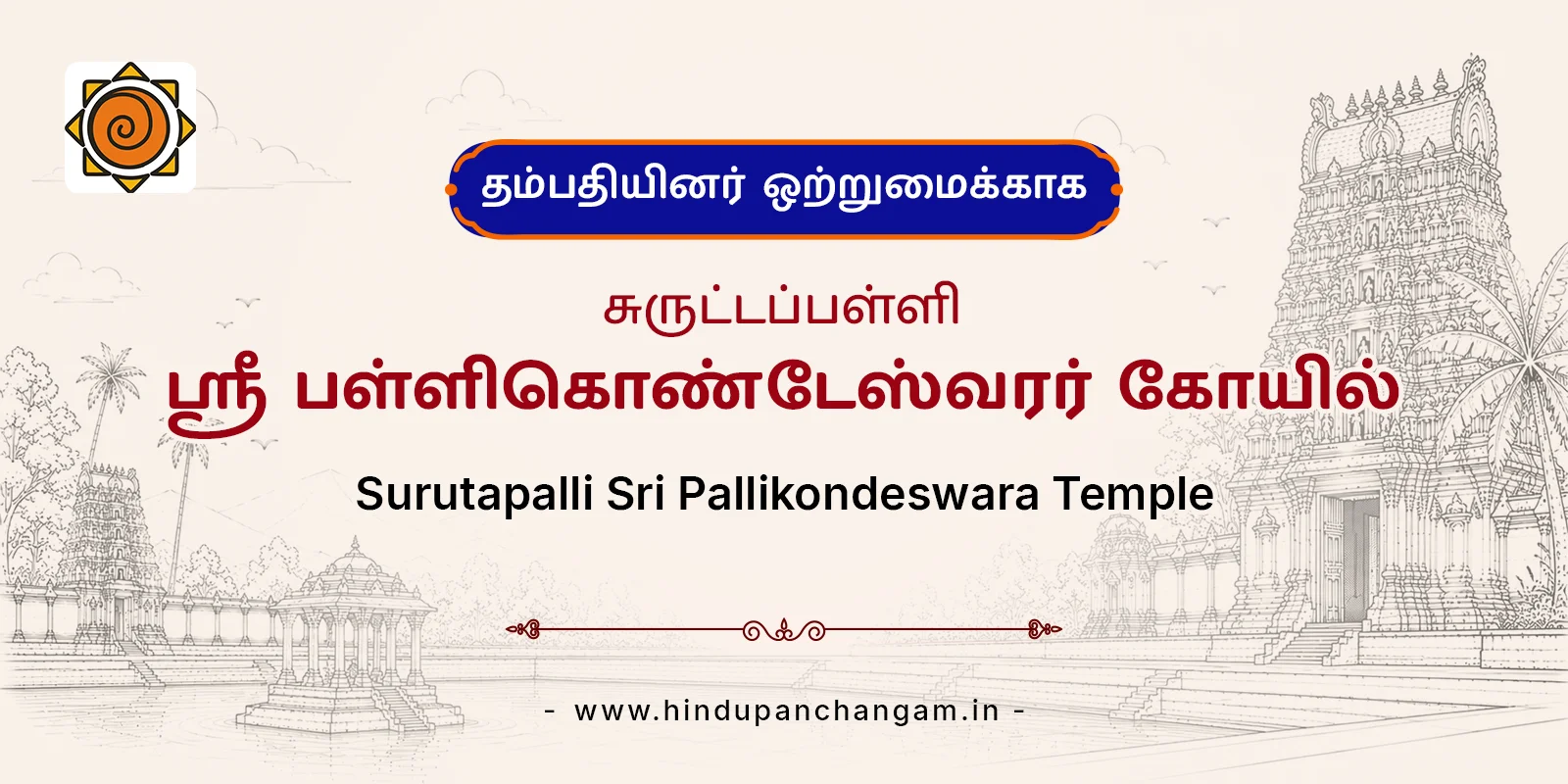
Surutapalli Sri Pallikondeswara Temple
Sri Pallikondeswara Swamy Temple is a historic Shiva temple at Surutupalle, in Tirupati district, Andhra Pradesh, close to the Tamil Nadu–Andhra Pradesh border and only a few kilometres from Uthukottai.
The presiding deity is Lord Pallikondeswara, a rare manifestation of Lord Shiva in a reclining human form, with His head resting on the lap of Goddess Parvati. The Goddess is worshipped as Sarvamangala / Maragathambigai.
This reclining form is the temple's greatest uniqueness. Unlike the usual Shiva temples where Shiva is worshipped primarily as a Shiva Lingam, here the principal deity is represented in a reclining posture, somewhat reminiscent of the reclining form of Lord Vishnu.
The temple is also popularly known as Pradosha Kshetram, because of its deep traditional association with Pradosha worship.
| Moolavar | Sri Pallikondeswarar |
|---|---|
| Goddess | Sri Maragathambigai |
| Tradition | Shaivam |
| Theertham | - |
| Timings | 5:00 AM – 1:00 PM, 3:30 PM – 8:30 PM |
Best Time to Visit
While every Pradosham day is highly auspicious, the months of October/November (for Aipasi Annabishekam) and February/March (for Maha Shivaratri) are culturally the most vibrant times to visit.
Why this temple is a Parigara Sthalam
Surutupalle is particularly suitable to be described as a Parigara Sthalam because devotees traditionally approach Lord Pallikondeswara during Pradosha Kala seeking relief from difficulties and obstacles.
The temple's spiritual importance comes from three major elements:
- Neelakantha form of Shiva – Shiva who accepted the poison to protect creation.
- Shiva resting on Parvati's lap – representing divine protection, compassion and restoration.
- Pradosha Kshetram – especially associated with worship during Trayodashi Pradosham.
Devotees traditionally believe that Pradosha worship here can help with:
- removal of obstacles
- peace of mind
- family harmony
- marital difficulties
- financial difficulties
- relief from prolonged struggles
- protection from negative influences
- general well-being
- spiritual purification
Sthala Puranam (Legend)
The principal Sthala Purana of Surutupalle is associated with the Samudra Manthan and Lord Shiva's manifestation as Neelakantha.
According to the traditional story, when the Devas and Asuras churned the Ocean of Milk, the deadly poison Halahala emerged. The poison threatened the entire creation.
To protect the universe, Lord Shiva consumed the poison.
Goddess Parvati, concerned that the poison should not enter Shiva's body, held His throat. The poison therefore remained in His throat, turning it blue, and Shiva came to be known as Neelakantha – the Blue-Throated One.
After consuming the poison, Lord Shiva became tired and uncomfortable. When He reached this region, He rested with His head on the lap of Goddess Parvati.
The Devas and sages are traditionally said to have gathered around Shiva, concerned about His condition and awaiting His recovery.
This divine resting posture is believed to be represented by the deity at Surutupalle.
Thus the name Pallikondeswara is associated with the Lord who is reclining/resting here.
Connection with Pradosham
Another important tradition connects the temple with the origin of Pradosha worship.
According to the traditional account, after Shiva consumed the poison and protected the universe, the Devas later worshipped Him on Trayodashi. Shiva, pleased with their devotion, performed His divine dance during Pradosha time.
The moment is traditionally associated with the sacred relationship between Shiva, Parvati and Nandi, and Pradosha worship became especially important at this kshetra.
It should be understood that the claim that Pradosha worship historically originated at Surutupalle is a traditional temple belief, rather than a fact that can be independently established historically. The temple is nevertheless widely recognized for its exceptional Pradosha observance.
Lava–Kusha tradition
There is also a local tradition connecting Surutupalle with Lava and Kusha, the twin sons of Lord Rama.
According to the tradition, after the episode involving the Ashwamedha horse, Lava and Kusha came to this region along with Sage Valmiki and worshipped Lord Shiva.
A stone bearing footprints is associated with this tradition. Historical accounts record that during the 1970s, Kanchi Mahaswami Sri Chandrasekharendra Saraswati visited the temple area and, according to the temple tradition, identified the footprints as those of Lava and Kusha after excavation.
Parigaram (Remedy)
Those facing delays in marriage light ghee lamps (Nei Deepam) equivalent to their age in front of the Thambathya Dakshinamurthy shrine. For instance, a 25-year-old would light 25 lamps. Offering prayers to Nandhi with an Arugampul garland (Bermuda grass) and Kapparisi (sweetened rice) is also a highly sacred remedy.
For family / marriage problems
Couples or families seeking harmony traditionally pray to Pallikondeswara and Sarvamangala together.
For mental peace
Pradosha worship, Shiva Nama Japa and quiet meditation are traditionally recommended.
For obstacles
Pray at Nandi and Lord Shiva during Pradosha Kala and perform Archana according to temple practice.
Who should worship
Devotees facing obstacles in marriage or relationships, individuals seeking relief from Navagraha doshas, and anyone desiring peace of mind and success in their endeavors.
What to do when you visit
- irst, worship the Swayambu Lingam (Valmikiswarar) and Goddess Maragathambal (standing on a lion vehicle).
- Visit the main Pallikondeswarar shrine where Shiva reclines on Parvati’s lap.
- Unlike standard Shiva temples, you are given Theertham (holy water) and Sadari (placed on the head) instead of Vibhuthi (holy ash) at the main shrine—receive this with reverence.
Before You Visit
- Check the temple's current timings before travelling.
- On Pradosham and Maha Shivaratri, expect heavy crowds.
- Reach early if you want a peaceful darshan.
- Wear modest traditional/comfortable clothing.
- Carry water, especially during hot months.
- If performing a specific Archana or Seva, confirm availability at the temple office.
- Do not assume that every ritual can be performed by devotees personally.
- Follow the temple's instructions regarding photography and offerings.
- If travelling with elderly people, plan for the crowd and waiting time.
- On major festival days, allow additional travel time.
Special Rituals / Abhishekam
Because Shiva is reclining, traditional water Abhishekam is not performed on the main Pallikondeswarar idol; instead, Thaila Kappu (anointing with special oil) is done. Pradosham pooja is the most vital ritual here, as legends say the very concept of "Pradosham" originated at this location when Shiva woke up and performed the Ananda Thandavam on Nandi's horns.
Festivals
- Pradosham (celebrated fortnightly with immense grandeur)
- Maha Shivaratri (draws over 30,000 devotees)
- Brahmotsavam (September - October)
- Aipasi Annabishekam (October - November)
- Thiruvadhirai (December - January)
How to Reach
Surutupalle is extremely close to Uthukottai in Tamil Nadu.
The temple is approximately 2 km from Uthukottai Bus Stand. Buses travelling towards Uthukottai / Chennai on this route can be used, followed by a short local journey to the temple.
From Chennai
Travel towards Red Hills → Periyapalayam → Uthukottai → Surutupalle.
The temple lies on the Tirupati/Uthukottai route and is in Andhra Pradesh, just beyond the Tamil Nadu border.
From Tirupati
The temple is approximately 70–75 km from Tirupati depending on the route used.
By Railway
Different travel sources give different nearest railway options. For practical pilgrimage planning, Tiruvallur, Puttur and Tirupati/Renigunta can be considered depending on the direction from which you are travelling, followed by road transport.
By Air
Tirupati Airport is the most practical nearby airport for pilgrims approaching from Andhra Pradesh/Tirupati side. Some travel sources place it around 60–75 km from the temple depending on the route.
Nearby Temples
| Temple | Distance |
|---|---|
| Sri Vedanarayana Swamy Temple | 11 km |
| Sri Kalyana Venkateswara Swamy Temple | 36 km |
| Sri Kalahasteeswara Swamy Temple | 60 km |
| Sri Parasurameswara Temple | 62 km |
| Sri Padmavathi Devi Temple | 69 km |
| Tirumala Sri Venkateswara Swamy Temple | 75 km |
Location Map
Is this temple right for you? Know your chart.
Find out which dosha affects your chart, the parigara temple best suited to you, and the exact remedies to perform — in a 30-minute personal consultation with Jyotishacharya Sermaraj.
₹499 — Book Personal Consultation → Jyotishacharya S. Sermaraj M.B.A. · HinduPanchangam.in · 01 Sep 2026