
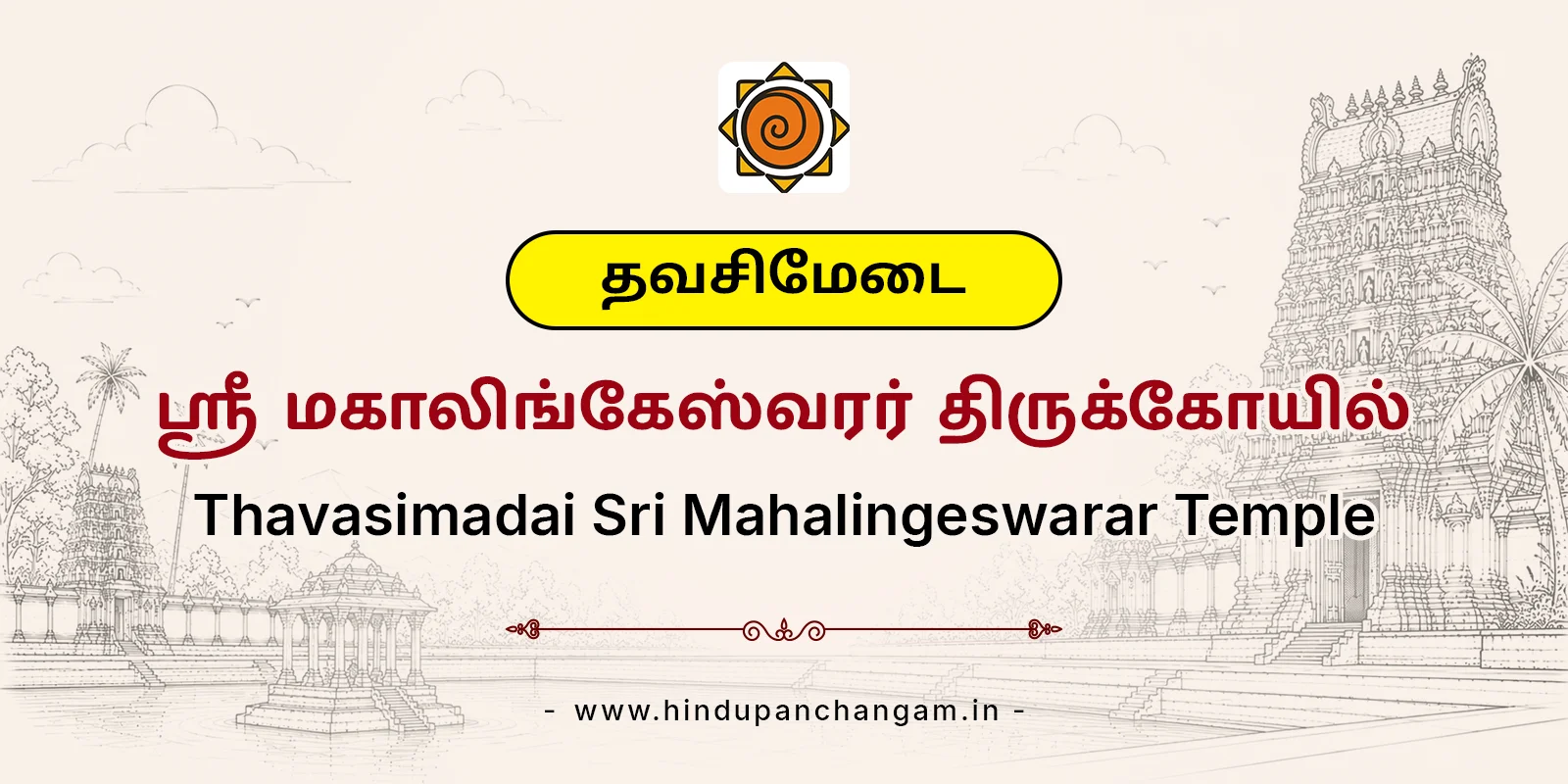
Thavasimadai Sri Mahalingeswarar Temple
Sri Mahalingeshwarar Temple at Thavasimadai, also known as Odukkam Thavasi Medai, near Viralipatti in Dindigul District, is one of the sacred temples traditionally associated with Magha (Magam) Nakshatra.
The presiding deity is Lord Mahalingeshwarar, facing east. The Divine Mothers Maragathavalli and Manickavalli grace devotees from a single shrine—a rare feature of this temple.
The temple stands in a serene setting near the foothills of Sirumalai, surrounded by the quiet atmosphere traditionally associated with sages, siddhars and ascetics. The temple is particularly connected with Sage Bharadwaja, who performed intense penance here.
The name Odukkam Thavasi Medai itself reflects this sacred tradition. Odukkam refers to restraint and withdrawal of the senses, while Thavasi Medai means the elevated place or platform where an ascetic performed penance.
The temple is especially important for people born under Magha Nakshatra. Special worship is performed every month on Magha Nakshatra day, and devotees seek relief from astrological obstacles, health difficulties, Vastu-related problems and other life challenges.
Another extraordinary feature is the presence of Aadhi Bhairava directly in front of Lord Mahalingeshwarar. Behind the Aadhi Bhairava shrine is a small opening through which devotees can obtain the darshan of Mahalingeshwarar, creating a distinctive Shiva–Bhairava worship experience.
The temple is also associated with several siddhars and sages, and traditions connected with Rama, Anjaneya, Vasishta Maharishi and Bharadwaja Maharishi further enrich its sacred history.
This is an unusually simple and spiritually austere temple.
The temple has:
- No separate Utsava Murti
- No conventional flagstaff
- No gopuram kalasams
- No hundi
- No regular Kumbhabhishekam under the usual Agamic pattern
This simplicity is closely associated with the temple's ancient ascetic character and its connection with sages and siddhars.
| Moolavar | Sri Mahalingeshwarar |
|---|---|
| Goddess | Sri Maragathavalli and Sri Manickavalli |
| Tradition | Shaivam |
| Nakshatra | Magha |
| Theertham | - |
| Timings | 6:00 AM – 10:00 AM, 6:00 PM – 8:00 PM |
Best Time to Visit
The 30 days immediately following Mahashivaratri (usually February - March / Masi month) are the absolute best times to witness the miraculous Sun rays falling on the deities. Otherwise, plan your visit on the day the Magam star aligns in any month.
Why this temple is a Parigara Sthalam
In Vedic astrology, Sage Bharadwaja is considered the supreme guiding Guru for those born under the Magam (Magha) Nakshatra. Because he attained immense spiritual power and realized Lord Shiva at this exact location, the soil and the deity here radiate the specific cosmic frequencies required to neutralize the doshas (astrological afflictions) of the Magam star.
Who should worship?
By Planet — Ketu
- Individuals currently undergoing Ketu Mahadasha (a 7-year period) or Ketu Antardasha.
- People with Kala Sarpa Dosha or Ketu Dosha in their birth chart (Kundli).
- Those facing mysterious health issues, sudden detachment, career breaks, or feelings of isolation.
- Seekers of spiritual enlightenment, occult knowledge, intuitive growth, and Moksha (liberation).
By Nakshatra
- People born under Magha Nakshatra
- Those facing difficulties associated with their birth star
- People seeking relief from adverse planetary influences
- Those seeking traditional Ketu-related remedies
- People experiencing prolonged illness
- Those seeking protection from negative influences
- People facing Vastu-related difficulties
- Those seeking family prosperity
- People connected with Bharadwaja Gotra
- Those seeking blessings from their ancestral and spiritual lineage
- People who wish to strengthen discipline, spiritual focus and inner stability
The temple is also open spiritually to devotees born under all 27 Nakshatras. Magha-born devotees, however, have a particularly strong traditional connection with this shrine.
Mantra & Slokam
By Planet — Ketu
Om Aswadhwajaya Vidhmahe Soola Hasthaya Dheemahi Thanno Ketu Prachodayath
By Nakshatra
Om Maha Anagaya Vidmahe Pitriyadevaya Dheemahi Tanno Maghah Prachodayat
Parigaram Items
| Item | Purpose |
|---|---|
| Kollu (Horse Gram) | Donate |
| Red Lily | Pooja |
| Multi-colored Cloth | Donate |
How to perform Parigaram at home
The ruling deity for Ketu is Lord Ganesha. The simplest home remedy is to worship Lord Ganesha daily.
- When: Tuesdays or Saturdays.
- How: Light a mud lamp with mustard oil or sesame oil facing the North-West direction. Offer Dharba grass (Kusha grass) or Arukampul (Bermuda grass) to Lord Ganesha and chant the Ketu Gayatri mantra 108 times.
Sthala Puranam (Legend)
The central sacred tradition of Thavasimadai is connected with Bharadwaja Maharishi, one of the great sages of Sanatana Dharma.
Bharadwaja Maharishi came to this sacred region and undertook deep penance worshipping Lord Shiva. He withdrew his senses from worldly distractions and remained absorbed in meditation upon Mahalingeshwarar.
The place where the Maharishi performed this intense penance came to be revered as Odukkam Thavasi Medai—the sacred platform of the ascetic who practised restraint and penance.
Bharadwaja Maharishi's association with Magha Nakshatra is the reason this temple became especially sacred for Magha-born devotees.
Every month, on Magha Nakshatra day, special worship is performed here in honour of the Maharishi and Lord Mahalingeshwarar.
Vasishta Maharishi and the Lingam
The sacred tradition of the temple states that the Shiva Lingam was installed by Vasishta Maharishi and was subsequently worshipped by Bharadwaja Maharishi.
Thus, the temple carries a sacred succession of Maharishi worship: Vasishta established the divine presence, and Bharadwaja continued the worship through intense penance.
The temple is therefore particularly significant for those belonging to the Bharadwaja Gotra, who traditionally visit this shrine and offer worship to their spiritual lineage of sages.
Rama, Anjaneya and the Sacred Banana Leaf Tradition
The temple tradition also connects the sacred place with Sri Rama and Hanuman.
During Rama's journey after the events in Lanka, Rama, Sita and Lakshmana came to the hermitage associated with Bharadwaja Maharishi.
Rama honoured Hanuman for his unwavering service during the search for Sita and the battle against Ravana. While sharing food with Hanuman on a banana leaf, Rama drew a line across the leaf so that the food could be shared.
The sacred tradition connects this act with the distinctive central division seen in banana leaves today.
The place is therefore remembered as a sacred meeting ground of Rama, Hanuman and Bharadwaja Maharishi.
Parigaram (Remedy)
Individuals born under the Magam star are advised to spiritually accept Sage Bharadwaja as their Guru. They must visit this temple specifically on Magam star days, perform Abhishekam (holy bath) and Archana to Lord Mahalingeswarar, and meditate peacefully to clear life obstacles and seek wisdom.
What to do when you visit
A meaningful visit may follow this sequence:
Vinayaka → Mahalingeshwarar → Maragathavalli → Manickavalli → Aadhi Bhairava → Special Darshan through the opening → Chandikeswarar → Prakara worship
Spend a few quiet moments before Mahalingeshwarar.
For Magha Nakshatra worship, you may pray:
“O Mahalingeshwara, by the grace of Bharadwaja Maharishi, remove the obstacles connected with my birth star, protect my family, bless my lineage and guide me towards dharma and prosperity.”
Before You Visit
This is a secluded, Siddhar-centric temple located in a quiet village, not a bustling commercialized tourist spot. Therefore, carry your own pooja items (flowers, fruits, camphor, etc.) as local shops might not be well-stocked. Prepare yourself mentally for a deeply meditative experience rather than a quick sightseeing tour.
Special Rituals / Abhishekam
The following worship practices are especially associated with this temple:
Magha Nakshatra Puja
Special worship is conducted every month on Magha Nakshatra day for Bharadwaja Maharishi and Lord Mahalingeshwarar.
Masi Magam Worship
Special pujas are performed during Masi Magam, one of the important annual occasions at the temple.
Abhishekam
Devotees perform abhishekam to Lord Mahalingeshwarar and offer vastras to the Lord and the Divine Mothers.
Ghee Lamp for Health
Devotees traditionally light ghee lamps seeking relief from illness and improvement in wellbeing.
Aadhi Bhairava Worship
Aadhi Bhairava receives special worship on:
- Amavasya
- Pournami
- Pradosham
- Theipirai Ashtami
- Magha Nakshatra
Learn More
In astronomy, Ketu is the South Node of the Moon—the mathematical point where the Moon's orbit crosses the Sun's path from north to south. In Vedic astrology, Ketu is a shadow planet (Chhaya Graha), traditionally depicted as a headless body with a serpent's tail. While Rahu represents material desires, Ketu is the exact opposite. Ketu acts as a "vacuum cleaner"—it represents detachment, isolation, hidden knowledge, intuition, past-life karma, and ultimate spiritual liberation (Moksha). Ketu takes away material attachments to teach spiritual lessons, which is why it often brings sudden, unexpected changes, but it also rewards with profound wisdom.
Charity / Daana
What to donate: Multi-colored clothes or blankets, black/white sesame seeds, and Kollu (Horse gram).
To whom: Spiritual seekers, ascetics, or the elderly. Feeding street dogs is widely considered one of the most powerful remedies to appease Ketu.
Key Facts
Favorable / Unfavorable Signs
Exalted (Highly Favorable/Uchcham): Scorpio (Vrichika) and Sagittarius (Dhanusu) [varying by tradition, but generally these two].
Debilitated (Unfavorable/Neecham): Taurus (Rishaba) and Gemini (Mithuna).
Friendly Planets: Venus, Saturn, and Mercury.
Enemy Planets: Sun, Moon, and Mars.
Festivals
Important worship occasions include:
1. Magha Nakshatra – Every Month
The most important recurring occasion for this temple. Special worship is performed for Bharadwaja Maharishi and Lord Mahalingeshwarar.
2. Masi Magam
Masi Magam is celebrated with special worship for Lord and Mother.
3. Maha Shivaratri
The period around Maha Shivaratri is particularly significant because of the extraordinary sunlight alignment that follows it.
4. Pradosham
Pradosham worship is especially significant, with special observance also connected to Aadhi Bhairava.
5. Amavasya and Pournami
Special worship is offered to Aadhi Bhairava on these days.
6. Theipirai Ashtami
Aadhi Bhairava worship is particularly significant on the waning Ashtami.
How to Reach
By Road: The temple is located in the Dindigul district on the route towards Natham. From Dindigul town, it is approximately 25-30 km. You can take a bus heading to Natham and get down at the Viralipatti (Thavasimadai) stop.
By Train: The nearest major railway station is Dindigul Junction.
By Air: Madurai International Airport is the closest airport (approx. 65 km away).
Location Map
Is this temple right for you? Know your chart.
Find out which dosha affects your chart, the parigara temple best suited to you, and the exact remedies to perform — in a 30-minute personal consultation with Jyotishacharya Sermaraj.
₹499 — Book Personal Consultation → Jyotishacharya S. Sermaraj M.B.A. · HinduPanchangam.in · 07 Sep 2026