
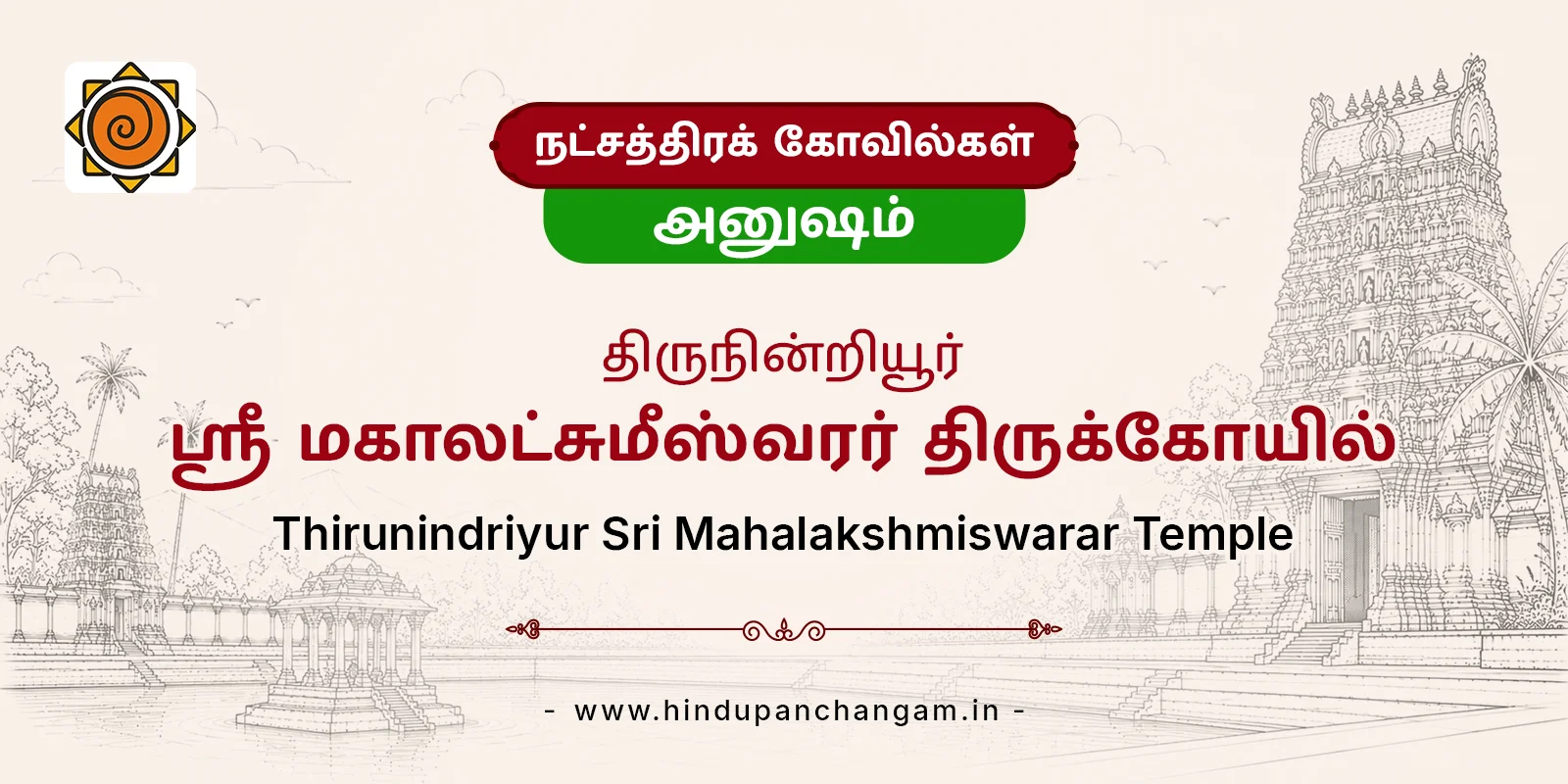
Thirunindriyur Sri Mahalakshmiswarar Temple
Sri Mahalakshmeeswarar Temple at Tirunindriyur is an ancient and spiritually significant Shiva temple located in Mayiladuthurai District, Tamil Nadu. The temple lies on the Mayiladuthurai–Sirkazhi route and is traditionally celebrated as the Anusham (Anuradha) Nakshatra Parihara Sthalam.
The presiding deity is Sri Mahalakshmeeswarar, also known as Sri Lakshmipureeswarar, and the Goddess is Sri Ulaganayaki Amman.
The Lord is a Swayambhu Shiva Lingam, and the temple has a long association with the great Shaiva saints Thirugnana Sambandar, Thirunavukkarasar (Appar) and Sundarar, who praised this sacred place in the Thevaram hymns.
Tirunindriyur is traditionally regarded as the 19th Shiva Sthalam on the northern bank of the River Kaveri praised in the Thevaram tradition.
The temple is also connected with Mahalakshmi, who performed worship and tapas here and received the grace of Lord Shiva. Because Shiva blessed Mahalakshmi at this sacred place, the Lord came to be known as Mahalakshmeeswarar, and the place acquired the sacred name Lakshmipuram.
Another important legend connects the temple with Parasurama and Sage Jamadagni. Parasurama came here after the killing of his mother Renuka and worshipped Lord Shiva for release from the resulting sin. Jamadagni also worshipped Shiva here and sought forgiveness.
The temple has a three-tier Rajagopuram, an expansive prakara and several important shrines, including Selva Ganapathy, Dakshinamurthy, Lingodbhava, Brahma, Durga, Murugan with Valli and Deivanai, Mahalakshmi, Parasurama, Bhairava and the Navagrahas.
For devotees born under Anusham Nakshatra, the temple has special significance. Special worship is traditionally performed for Selva Ganapathy on Anusham days, and devotees also perform parihara worship here for adverse planetary influences and other life obstacles.
| Moolavar | Sri Mahalakshmeeswarar (Sri Lakshmipureeswarar) |
|---|---|
| Goddess | Sri Ulaganayaki Amman |
| Tradition | Shaivam |
| Nakshatra | Anuradha |
| Theertham | Neela Poigai / Lakshmi Theertham |
| Timings | 6:00 AM – 11:00 AM, 4:00 PM – 8:00 PM |
Best Time to Visit
The Tamil month of Aani (June-July) is highly festive. However, for Nakshatra Parigaram, visiting on the Anusham (Anuradha) Nakshatra day of any month yields the absolute best astrological benefits.
Why this temple is a Parigara Sthalam
The temple is astrologically anchored to the Anusham (Anuradha) Nakshatram. The Chola King laid the foundation for this temple specifically on the day of the Anusham star. Furthermore, Anusham starrers are known to be fond of travel, occupy high positions, and command respect. The cosmic vibrations here continuously nourish the ruling planetary energies of Anusham. Thus, the temple acts as a spiritual magnet that cures doshas, clears debts, and elevates the career of Anusham natives.
Who should worship?
- People born under Anusham / Anuradha Nakshatra.
- Those wishing to perform Janma Nakshatra Pariharam.
- People facing repeated obstacles or delays.
- Those experiencing debt-related difficulties.
- People seeking financial stability and prosperity.
- Those experiencing instability in livelihood or business.
- People praying for family welfare and harmony.
- Those seeking relief from adverse planetary influences.
- People beginning a new financial or professional phase.
- Those seeking spiritual purification and forgiveness.
- Families seeking prosperity and stability.
- People wishing to strengthen discipline, patience and long-term stability associated with Saturn's influence.
Anusham-born devotees can visit the temple even when there is no specific difficulty. Performing worship on one's Janma Nakshatra day can become a regular spiritual practice.
Mantra & Slokam
Chanting this specific Gayatri mantra invokes the protective and prospering cosmic energy of the star. It is ideal to chant this 108 times on Anusham star days.
Om Mitra Devaaya Vidmahe Mahaa Mitraaya Dheemahi Thanno Anuradha Prachodayaat
Sthala Puranam (Legend)
The Divine Grace of Mahalakshmi
The most important Sthala Puranam of Tirunindriyur is associated with Mahalakshmi. Mahalakshmi came to this sacred place and performed worship and tapas to Lord Shiva. She prayed for a divine blessing that would establish her eternally upon the chest of Lord Vishnu. Lord Shiva appeared before Mahalakshmi and asked her what boon she desired. Mahalakshmi expressed her wish to remain eternally upon the chest of Lord Vishnu. Lord Shiva granted her this blessing. Because Lord Shiva bestowed His grace upon Mahalakshmi at this sacred place, the Lord came to be worshipped as Mahalakshmeeswarar. The sacred place also became known as Lakshmipuram. This legend gives the temple a beautiful connection between Shaiva and Vaishnava traditions. Mahalakshmi, the divine consort of Vishnu, worshipped Shiva here and received His blessing.
The Legend of Parasurama
Another important Sthala Puranam is connected with Parasurama. Sage Jamadagni's wife was Renuka Devi. One day, Jamadagni became angry with Renuka and ordered his son Parasurama to kill her. Obeying his father's command, Parasurama carried out the order. Later, through the boon granted by his father, Parasurama brought his mother back to life. Although his mother was restored to life, Parasurama was burdened by the sin arising from the act of killing his mother. He came to Tirunindriyur and worshipped Lord Shiva. Lord Mahalakshmeeswarar granted him grace and released him from the burden of the sin. Sage Jamadagni also worshipped Lord Shiva here and sought forgiveness for his own action. A separate image of Parasurama is preserved in the temple, commemorating this sacred tradition.
The Legend of the Chola King and the Extinguished Torches
Another important story explains the discovery of the Swayambhu Lingam. A Chola king had a deep devotion to Lord Nataraja at Chidambaram and regularly travelled to Chidambaram for darshan. During one such journey, the king and his attendants passed through Tirunindriyur at night. As soon as they reached a particular area, the torches carried by the soldiers suddenly went out. They tried to light them again, but the flames repeatedly disappeared while they remained within that particular area.
Once they moved beyond the sacred spot, the torches began burning normally. The same phenomenon occurred again on the return journey. The king became curious and ordered his minister to investigate. The minister questioned the local people and learned about a remarkable event: Kamadhenu, the divine cow, descended to this place and poured her milk over a particular spot. The king and his men went to the location. While walking there, the king's foot became trapped in the mud. The minister brought an iron implement to help him pull himself out. When the king drove it into the ground, blood sprang from the earth. The king was shocked. The place was excavated, and a Shiva Lingam was discovered. The king understood that the Lingam was a Swayambhu manifestation of Lord Shiva and established the temple there.This became the sacred shrine of Tirunindriyur.
The Name Tirunindriyur
The ancient name of the place is given as Tirunindra Oor / Tirunindriyur. The sacred traditions of the temple connect the place with the divine presence of Shiva, Mahalakshmi, Parasurama, Agastya and other divine beings who worshipped here. The temple therefore carries several layers of sacred history — Mahalakshmi's tapas, Parasurama's worship, the Chola king's discovery of the Swayambhu Lingam and the devotional heritage of the Nayanmars.
Parigaram (Remedy)
Nakshatra Parigaram: People born under the Anusham star are advised to visit the temple on their star days, birthdays, or wedding anniversaries. The ultimate remedy is covering Lord Shiva completely with Sandal Paste (Santhana Kaappu) and decorating the Lingam with Pomegranate seeds (pearls) to ensure a happy and prosperous future.
Debt Clearance: The Lord Ganesha here is named Selva Ganapathy. Devotees struggling with severe debts or financial blockages pray to Him, firmly believing He swiftly clears all predicaments.
Ancestral Salvation: Offering prayers at the Navagraha shrine on New Moon days (Amavasya) brings salvation to departed ancestors.
What to do when you visit
- Worship Selva Ganapathy for wealth and debt relief.
- In the main sanctum, closely observe the Shiva Lingam to see the ancient axe cut scar (a mark of the Chola king's mistake).
- Worship Lord Dakshinamurthy. Pay attention to the demon (Muyalagan) under His feet; unusually, the demon holds a snake turning to the left, and the Lord blesses him with His left hand.
- In the Navagraha shrine, notice the highly rare arrangement where the Sun (Suryan) and Moon (Chandran) face each other.
- Visit the shrines of Parasurama Lingam and Jamadagneeswarar.
Before You Visit
The unique remedy for Anusham star involves pomegranate seeds. It is highly recommended to buy fresh pomegranates from your town or Mayiladuthurai before heading to the temple, as local village shops might not have them readily available. Inform the priests beforehand if you plan to do the Santhana Kaappu (Sandal paste covering) ritual.
Special Rituals / Abhishekam
Special Poojas are performed for Lord Selva Ganapathy and Lord Mahalakshmeeswarar precisely on Anusham star days every month. Performing Abhishekam (sacred bath) offering Vastrams (clothes), and decorating the Lord with Sandalwood paste and Pomegranate pearls is the highest form of worship here.
Festivals
Aani Thirumanjanam: Aani Thirumanjanam is one of the important annual festivals of the temple and is associated with special Shiva worship.
Maha Shivaratri: Maha Shivaratri is celebrated with special worship, Abhishekam and night prayers.
Thirukarthikai: Karthigai Deepam is observed with special lamps and Shiva worship.
Aippasi Annabhishekam: Aippasi Pournami Annabhishekam is one of the temple's distinctive annual observances.
Skanda Sashti: Special worship for Lord Murugan is performed during Skanda Sashti.
Vinayagar Chathurthi: Special worship is performed for Lord Vinayaka during Avani.
Pradosham: Pradosham occurs twice every lunar month and is an important recurring Shiva worship occasion.
Anusham Nakshatra Days: Anusham Nakshatra days have special significance for devotees following the temple's Nakshatra Parihara tradition.
How to Reach
By Road: Tirunindriyur is located about 7 km from Vaitheeswaran Koil and roughly 12 km from Mayiladuthurai. You can take a bus heading towards Sirkali from Mayiladuthurai and get down near the village junction. Auto-rickshaws are easily available from Vaitheeswaran Koil.
By Train: Mayiladuthurai Junction and Vaitheeswaran Koil Railway Station are the nearest railheads.
By Air: Trichy International Airport is the nearest, located approximately 140 km away.
Nearby Temples
| Temple | Distance |
|---|---|
| Vaitheeswaran Koil (Mars/Sevvai Sthalam) | 7 km |
| Sri Mayuranathaswami Temple, Mayiladuthurai | 12 km |
| Sirkali Sattainathar Temple | 15 km |
| Chidambaram Thillai Nataraja Temple | 30 km |
Location Map
Is this temple right for you? Know your chart.
Find out which dosha affects your chart, the parigara temple best suited to you, and the exact remedies to perform — in a 30-minute personal consultation with Jyotishacharya Sermaraj.
₹499 — Book Personal Consultation → Jyotishacharya S. Sermaraj M.B.A. · HinduPanchangam.in · 26 Sep 2026