
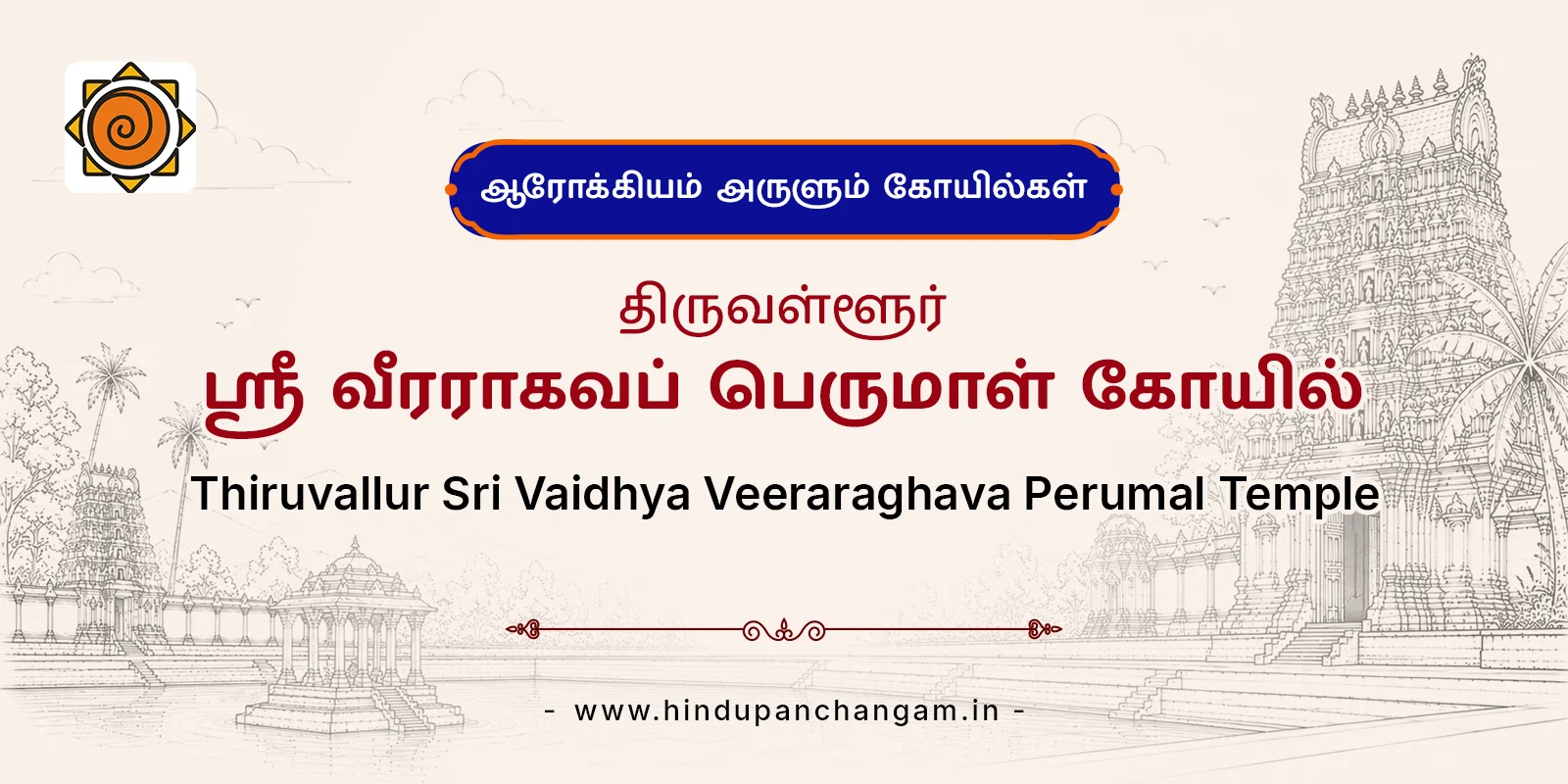
Thiruvallur Sri Vaidhya Veeraraghava Perumal Swamy Temple
Sri Vaidhya Veeraraghava Perumal Temple is one of the most important Vaishnava temples in Tamil Nadu and is one of the 108 Divya Desams. It is situated in Thiruvallur, about 50 km from Chennai.
The presiding deity is Sri Veeraraghava Perumal, also known as Evvul Kidanthan / Evvul Kidandhan, in a reclining posture. His consort is Sri Kanakavalli Thayar, also known as Vasumathi / Kanakavalli.
The temple is particularly famous as a prarthana sthalam for relief from illness and physical suffering, and therefore the Lord is popularly known as Vaidhya Veeraraghava Perumal — the Divine Physician. Traditional worship here includes offerings of salt and pepper for health-related prayers.
The temple is associated with the ancient name Evvulur, while the sacred tank is known as Hritthapanasini / Hrudayapanasini / Hrittapanasini Pushkarini. The temple follows the Pancharatra Agama tradition.
The temple is also celebrated in the Nalayira Divya Prabandham by Azhwars including Thirumangai Azhwar and Thirumazhisai Azhwar.
| Moolavar | Veeraraghava Perumal |
|---|---|
| Goddess | Kanakavalli Thayar |
| Tradition | Vaishnavam |
| Theertham | Hrith-Thapa-Nasini Pushkarini (the destroyer of mental and physical afflictions) |
| Timings | 6:30 AM to 12:00 PM, 4:00 PM to 8:00 PM |
Best Time to Visit
The weather is most pleasant from September to March. However, visiting during the Brahmotsavam months of Thai (January-February) or Chithirai (April-May) offers a culturally rich and vibrant experience.
Why this temple is a Parigara Sthalam
The Lord here is worshipped as "Vaidhya" Veeraraghava, meaning the "Healer God." It is a widely held belief that he cures severe, chronic illnesses and grants good health to his devotees, making it a highly revered parigara (remedial) sthalam for medical ailments.
Devotees traditionally visit this temple particularly for:
- People praying for relief from illness.
- Those experiencing prolonged physical suffering.
- People praying for recovery and good health.
- Families praying for the health of a family member.
- Those seeking relief from personal difficulties and suffering.
- Couples praying for progeny / childbirth blessings.
- Devotees who observe Amavasya prayers.
- Vaishnava devotees visiting the 108 Divya Desams.
Sthala Puranam (Legend)
The principal Sthala Puranam is associated with Salihotra Maharishi.
In the Krita Yuga, a sage named Purupunya / Purupunyar lived at Badarikashram with his wife Satyavathi. They had no children. The sage performed a great Putrakameshti / Sali Yajna, offering 1,000 oblations every day for an entire year.
At the completion of the yajna, Lord Narayana appeared and granted him the boon of a son. The child was named Salihotra, after the yajna.
As Salihotra grew up, he undertook pilgrimage to sacred places. Eventually he came to Tiruvallur on Thai Amavasya and took a sacred bath in the Hrittapanasini tank.
He then undertook a year-long penance.
After completing the penance, he prepared food from the grain he had collected. He divided the food into portions for the Lord, charity and himself.
At that moment, Lord Narayana appeared before him in the form of an old Brahmin.
The Brahmin asked for food and a place to rest. Salihotra, following the highest principle of hospitality, gave him the entire food he had prepared and offered him a place to stay.
The Lord then asked:
“Ev-vul?” — “Where is the place for Me to lie down?”
Because of this episode, the Lord came to be associated with the name Evvul Kidanthan / Evvul Kidandhan, meaning the Lord who reclined here.
The Sthala Puranam further narrates that Lord Narayana revealed His true divine form to Salihotra and blessed him.
Another important tradition associates the sacred tank with King Pradyumna, who performed severe penance seeking a child. Lord Narayana appeared to him on Thai Amavasya and granted his wish. The Lord also blessed the tank with exceptional sanctity.
Parigaram (Remedy)
As a remedy for health issues, stomach ailments, and skin diseases, devotees offer rock salt and whole black pepper (milagu) into a designated Hundi/box. They also take a holy dip in the temple tank. Furthermore, devotees offer small silver figures of specific body parts (like eyes, legs, or heart) afflicted by illness to pray for a cure.
What to do when you visit
First, take a holy dip or sprinkle a few drops of water from the temple tank (Hrith-Thapa-Nasini) on your head. Next, offer the rock salt and pepper in the respective mandapam. Visit the shrine of Goddess Kanakavalli Thayar before having darshan of the main deity, Sri Vaidhya Veeraraghava Perumal. Finally, perform a circumambulation (pradakshina) of the temple.
Before You Visit
Amavasya (New Moon) weekends attract massive crowds from across the state. If you want a peaceful darshan, visit on regular weekdays. Dress modestly in traditional attire (dhotis/formal wear for men; sarees, half-sarees, or salwar-kameez for women). Shorts, lungis, and sleeveless tops are strictly prohibited. Photography is not allowed inside the inner sanctum.
Special Rituals / Abhishekam
Because the deity is the Supreme Healer, Thirumanjanam (sacred bath) is performed with special care. The Moolavar (main stone deity) is treated exclusively with perfumed oil (Thylakappu) and sandalwood paste (Santhana Kappu). Water is not used for the Moolavar's abhishekam; only the Utsavar (processional deity) receives standard holy baths.
Festivals
The temple celebrates several important annual festivals.
1. Chithirai Brahmotsavam
A major 10-day Brahmotsavam is celebrated during Chithirai (approximately April–May), with processions and important concluding events.
2. Thai Brahmotsavam
Another important 10-day Brahmotsavam is traditionally celebrated during Thai (January–February).
The 2026 Thai Brahmotsavam chariot festival was held in January 2026, demonstrating that this remains an important contemporary festival at the temple.
3. Theppotsavam
The temple also has an annual float festival, traditionally associated with the temple tank. The municipal information identifies the Masi Thepporchavam as a three-day annual float festival beginning around Masi Amavasya.
4. Amavasya
Every Amavasya has special devotional significance at Thiruvallur, with particularly large numbers of devotees coming for darshan and prayer.
How to Reach
By Train: Thiruvallur Railway Station is on the Chennai Suburban Railway network and is highly convenient. It takes about 1 hour and 15 minutes from Chennai Central. The temple is about 5 km from the station.
By Bus: Frequent buses run from Chennai (approx. 45 km away) and Tirupati directly to Thiruvallur.
By Air: Chennai International Airport is the nearest (approx. 47 km).
Nearby Temples
| Temple | Distance |
|---|---|
| Sri Viswaroopa Panchamukha Anjaneyaswami Temple, Thiruvallur | 3 km |
| Sri Vaseeswarar Temple, Thirupachur | 3 km |
| Sri Hridayaleeswarar Temple, Thirunindravur | 15 km |
| Sri Bhakthavatsala Perumal Temple, Thirunindravur | 15 km |
Location Map
Is this temple right for you? Know your chart.
Find out which dosha affects your chart, the parigara temple best suited to you, and the exact remedies to perform — in a 30-minute personal consultation with Jyotishacharya Sermaraj.
₹499 — Book Personal Consultation → Jyotishacharya S. Sermaraj M.B.A. · HinduPanchangam.in · 01 Sep 2026